By FATHER JACK REICHARDT, Director of Vocations Office
The Observer staff, The Observer
As we at The Observer attend ordinations, parish missions and Masses at parishes hosting seminarians, we hear a variety of questions from supportive family members and parishioners. “How did you know you wanted to be a priest? How many years will you study? Why are you a deacon — aren’t you going to be a priest next year?”
It’s a lot to keep track of. After all, it takes even seminarians many years to learn!
So we wrote to Father Jack Reichardt, director of the diocesan Vocations Office, to clear up these frequently asked questions ahead of this year’s priesthood ordination June 6.
As World Day of Prayer for Vocations approaches on April 26, we also asked him about the process of discernment.
This is what he had to say.
Discerning a priestly vocation
Q How does a man start discerning a vocation to the priesthood?
A Good discernment begins with prayer and a relationship with Jesus Christ. Regular participation in the sacraments — especially the Eucharist and confession — are essential.
Spiritual direction is another great resource, as a priest who has been through the discernment process before can really help a man listen for God’s voice and grow in self-knowledge.
Other helpful resources include Scripture, Eucharistic adoration, books, retreats, and conversations with priests and seminarians.
You can find all these resources and more at RockfordPriest.org
Q There are two types of priests: diocesan and religious order priests. What’s the difference?
A A diocesan priest traces his lineage all the way back to the Apostles themselves. He makes promises of celibacy and obedience (but not poverty). He serves a specific geographic area (a diocese) under the authority of the bishop. His ministry is typically in a parish, where he celebrates the sacraments, preaches, and shepherds the local community. His spirituality is rooted in serving the people entrusted to him.
A religious order priest belongs to a specific religious community (such as Franciscans, Dominicans, or Jesuits) and takes vows — usually poverty, chastity, and obedience. His life is shaped by the charism (special focus or specific mission) and spirituality of that order. Religious priests may serve in ministries including education, missionary work, or specialized apostolates, and they may be assigned to different locations depending on the needs of their community.
Q I know someone who wants to become a religious order priest. How does he start that process?
A He should begin by researching different religious communities to learn about their charisms [those specific missions] and ways of life. In discerning religious life, discerning the charism comes first. Visiting their websites, reading about their founders, and learning about their apostolates can be helpful.
Most importantly, he should reach out directly to a vocation director for the community. Many orders offer retreats or “come and see” opportunities where a man can experience community life firsthand. Speaking with members of the order and seeking spiritual direction are also key steps.
Q I know someone who wants to become a diocesan priest. How does he begin the process to become a seminarian for
the diocese?
A He should contact the diocesan vocation director to begin a conversation (in the Diocese of Rockford, this is Father Jack Reichardt). The process typically includes several meetings to discuss
his background, faith life, and sense of calling.
Should the conversation continue and lead towards application, the vocation director would then walk with him through that process. He will be asked to complete a written application, which includes references, academic records, psychological evaluation, and background checks.
Throughout the process, the goal is to continually discern together whether God is calling him to the priesthood. If accepted, he is sent to a seminary for formation.
Seminarian life
Q Are there any required high school classes for a seminarian-to-be?
A There are no specific high school classes required to enter seminary. However, a solid academic foundation — especially in reading, writing, and critical thinking — is important. Classes in religion, philosophy, or languages can be helpful but are not required.
More important than coursework is a growing relationship with God, participation in parish life, and openness to discernment.
Q What do seminarians study? If they have other interests, can they study those too?
A Seminarians primarily study philosophy and theology, which provide the intellectual foundation for understanding the faith and serving as a priest. Philosophy helps develop clear thinking and addresses fundamental questions about truth, morality, and the human person. Theology focuses on Scripture, Church teaching, sacraments, and pastoral ministry.
Depending on the seminary and stage of formation, seminarians may also have opportunities to pursue other academic interests, especially if those interests support their future ministry. However, their primary focus remains preparation for the priesthood.
Q How many years do seminarians go to school? Does the diocese pay for anything?
A The length of seminary formation varies depending on a man’s background but typically ranges from seven to eight years. This includes undergraduate (philosophy) and graduate (theology) studies. For men who already have a college degree, the timeline may be shorter.
The diocese is supportive throughout seminary formation. The goal is to help alleviate financial burdens and pressures of the candidate so they can be free in their discernment.
Q I read in The Observer that seminarians now have an extra year: the propaedeutic year. What does that mean?
A The propaedeutic year [introduced to seminaries and vocation programs in 2022] is a preparatory year at the beginning of seminary formation. Its purpose is to help men deepen their spiritual lives, grow in human formation, and transition into the rhythm of seminary life.
During this time, there is a strong emphasis on prayer, community, and personal human growth rather than academics. It provides a solid foundation before beginning formal philosophical and theological studies.
Q Diocesan seminarians that I’ve met go to different schools. Why?
A Seminary formation is typically divided into two main stages: college-level (philosophy) and graduate-level (theology). They are often referred to as “minor” and “major” seminary. These stages are often completed at different seminaries because each institution specializes in a particular phase of formation.
The college-level seminary focuses on undergraduate studies (philosophy) and initial formation, while the graduate-level seminary provides advanced theological education and more intensive pastoral and ministerial preparation.
This structure allows seminarians to grow gradually and intentionally in their formation.
Q Who directs seminarians while they’re in school?
A While at seminary, seminarians are guided by a priest formator and formation team, which typically includes the rector [the priest appointed by his bishop to lead a seminary], spiritual directors, academic advisors, and others. The spiritual director plays a key role in helping the seminarian discern God’s will in his life.
The diocesan vocation director and bishop also remain involved, especially in major decisions about advancement toward ordination.
Q What does a seminarian do during the summer?
A Summer assignments are an important part of formation. Seminarians are typically assigned to parishes, where they gain practical pastoral experience by assisting with ministry, serving at Mass, and meeting parishioners. Some may also participate in specialized assignments such as hospital chaplaincy, missionary work, language immersion, or further studies.
Summers provide seminarians an opportunity to integrate what they have learned in the classroom with real-life ministry.
Taking steps toward the priesthood
Q What are some discernment milestones for seminarians?
A Throughout seminary, a man is continually discerning whether God is calling him to the priesthood. Key milestones include developing a consistent life of prayer, demonstrating emotional and relational maturity, growing in virtue, and showing a genuine desire to serve others. He should also demonstrate the ability to live in community and embrace the promises of celibacy and obedience.
Formal milestones in the Church include admission to candidacy, installation as a lector and acolyte, and eventually ordination to the transitional diaconate the year before priesthood.
Q Why are seminarians ordained deacons? How are they different from the deacons at my parish?
A Seminarians are ordained as transitional deacons as a step toward priesthood. That means every priest, even a bishop or the pope, was first ordained a deacon. This ordination allows them to begin exercising certain ministries, such as preaching, baptizing, and assisting at marriages, as part of their preparation for priesthood.
Permanent deacons, on the other hand, are ordained to the diaconate as their permanent vocation and are not preparing
for priesthood.
While both share the same sacramental order, their roles and life paths greatly differ.
Q What happens during priesthood ordination?
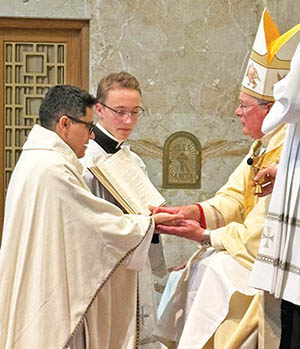
A Priesthood ordination is a sacred and joyful moment in which a man is configured to Christ as a priest. His soul is indelibly marked.
During the rite, the candidate makes promises of obedience and commitment to priestly life. The bishop lays hands on him — a gesture that traces back to the Apostles — and prays the prayer of ordination, invoking the Holy Spirit. The newly ordained priest is then vested with priestly garments and anointed on his hands with sacred chrism oil.
From that moment on, he is able to celebrate Mass, hear confessions, and serve God’s people as a priest of Jesus Christ.