
ROCKFORD—“This is fast becoming my favorite Mass of the year,” said Patrick Winn, former director of Catholic Charities. He was one of more than 50 people who gathered at the Cathedral of St. Peter the evening of May 15 for the annual St. Dymphna Mass to pray for people they know and those they don’t know who struggle with mental
health difficulties.
Current director of Catholic Charities, Cathy Weightman-Moore, agreed that “the Mass was lovely,” and that she is so grateful for Bishop David Malloy’s support of the ministry. She also noted that a second St. Dymphna Mass in the Fox Valley area was also happening that day.
All ages, from children to young adults to middle-aged people to seniors, came to the cathedral to pray, socialize and support one another and cheer each other on.
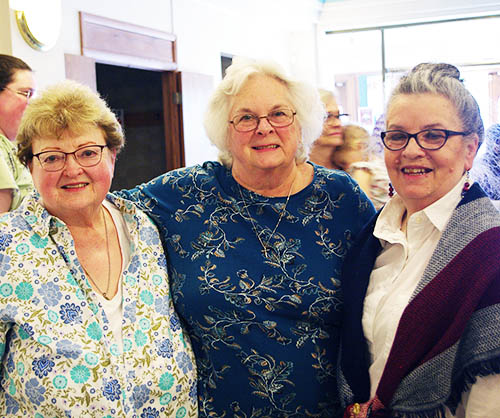
Janis Kolberg, Deb Sosnowski and Karen Kruse came from Crystal Lake’s St. Thomas the Apostle Parish where they volunteer with the parish mental health ministry. The parish has held Catholic Charities’ Mental Health Ministry’s programs such as the sanctuary course for interested parishioners.
The trio agrees with the need for such a ministry, with Kolberg noting how many in society are affected by loved ones’ suicides. Sosnowski shared that they are hoping to bring the McHenry Deanery churches together to form a larger mental health program so ideas and knowledge and spaces can be shared in the effort to help parishioners and others who deal with anxiety and depression, along with other mental illnesses.
Lissette Dominguez, who is active at both St. Anthony of Padua and SS. Peter and Paul (Rockford) parishes, hopes to work this summer with young people to build leaders and help other youths through them.
She comes to Rockford from Delaware where she worked with a mental health program for parents of, for example, ADHD. Once parents learn how to help their children, whole families are able to improve their family life, she said.
“There’s a great need, especially in our (Hispanic) culture,” Dominguez said, describing the common problem of misunderstanding and misinformation faced by many.
Kailee Kuropas currently heads up the Catholic Charities’ Mental Health Ministry.
People struggling with mental illness, and those trying to help them, she said, “find comfort in knowing the Church supports them.”
“People just want to know how best to accompany them,” Kuropas added, reflecting on how mental health difficulties have affected people for hundreds of years, but only now has it become “mainstream” with awareness and a lot of questions.
“People often look to the authority of the Church for answers,” she said, noting that “having the bishop support (this Mass and ministry) means a lot to the ministry and the people of the diocese … It helps them feel less alone.”
Bishop Malloy celebrated the annual Mass for the fourth year.
“This is the fourth anniversary, the fourth time that we’ve gathered to offer Mass,” he said, “but we’re also here to offer our special prayer and reflection concerning the growing awareness that is taking place of the presence of mental health issues and the ministry to care for those who are afflicted in their
mental health.”
The bishop briefly shared the story of St. Dymphna and how she came to be the patron of mental health. He pointed to the people of the small town in Belgium where she was martyred by her mentally-ill father around the year 650. When Dymphna’s hospital that helped people with mental health issues overflowed, he said, the townspeople opened their doors to those people, calling them, not patients, but “boarders.”
That town was still caring for some 4,000 boarders when World War II came about, Bishop Malloy said.
He also spoke of the “sense of isolation” experienced by so many, along with “internal pain” because it is an illness. Quoting the National Institute of Mental Health, the bishop noted that currently one in five adults lives with some form of mental illness. Depression, he added, is growing among young people along with high levels of anxiety, stress, and loneliness, affected in part by the
COVID-19 pandemic.
“Because this is an illness, real improvements can be found,” Bishop Malloy said, calling that the hope of the mental health ministry. Addressing what stands in the way of such help along with countering the stigma that lingers in society are two of the ways the ministry serves, he said.
“There is a context,” he added, pointing back to the people of the small Belgian town who took people into their own homes, and a similar effort by people from Poland who currently shelter refugees from Ukraine. He encouraged all to open their minds and hearts to this ministry and also to see the ministry as a response that gives hope.
In the context of prayer, Bishop Malloy encouraged a “resounding witness (that) we truly believe that prayer is effective … not simply a recitation that simply makes us
feel good.”
He noted the “heroic” work of some family members who care for those who are suffering from these kinds of illnesses, saying, “we can assist not only those who are afflicted but also those who are seeking to help them.” He called the still-new mental health ministry “one of the signs of our own times.”
God raised up in Dymphna a source of grace and prayer coming down to our own time, he said, concluding, “How great it is for us to be able to say, ‘St. Dymphna, pray for us.’”