By Megan Peterson, Features/Multimedia Editor
DEKALB—At the St. Agatha Atrium at Christ the Teacher University Parish, catechists prepare the learning environment for the littlest of
the faithful.
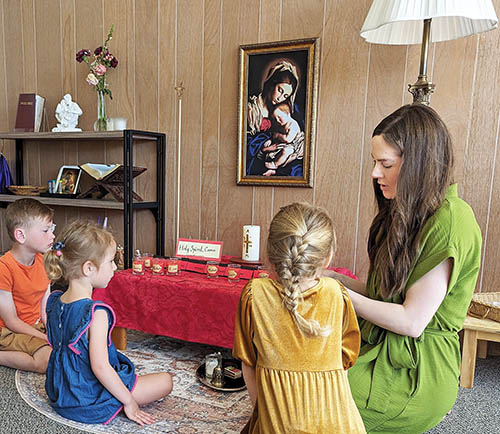
In the softly-lit space, they place a handmade chalice and paten on a model altar, set out maps of sites in Scripture, and arrange clay figurines of Biblical characters.
Here in the quiet, they pray that children will hear the voice of Jesus, the Good Shepherd.
On June 15-20, 9 a.m.-4:30 p.m., the atrium will host a class for adults to learn about Catechesis of the Good Shepherd (CGS), the Montessori-style religious education method started in Rome in the 1950s and now taught at Christ the Teacher. Carolyn Kohlhaas, a national CGS leader, will lead the Level 1B training, the second part of Level 1 formation which is needed to teach ages 3-6.
Whether attendees want to teach CGS or simply make a spiritual retreat, all are welcome, says Jenny Gray, Christ the Teacher’s CGS coordinator.
CGS spreads in the Rockford Diocese
Gray had studied behavioral health and was married and living in Seattle when one of her friends, a CGS catechist, gave her the book “The Child and the Church” by Dr. Maria Montessori.
Gray picked it up when her firstborn was around 18 months old. In the book, Dr. Montessori connected catechesis to her educational model, which focused on helping children learn in environments that were designed to support their natural development.
Gray thought, “This rings true to me.”
Later, living in the Rockford Diocese, she attempted to attend a training that was canceled. In 2023, she attended a Level 1 training in Janesville, Wis., as a spiritual retreat.
“As I was at training,” she recalls, “I really felt the Holy Spirit put on my heart that He was going to ask something more from me.”
She felt called to start a CGS program at Christ the Teacher. The director of religious education, Rachel Johnsen, and Father Robert Gonnella, pastor, were open to the idea.
“The Holy Spirit continued to pour out confirmation that this was … God’s will,” she says. A Newman Center office room became the atrium. Parishioners helped with setup. Atrium assistant Michaela McMahon contributed her engineering background and crafting gifts.
Michaela’s sister-in-law Lauren McMahon later joined as a catechist after her oldest son had been in CGS for two years. And when Christ the Teacher hosted Level 1A training last year, attendee Megan Kramer went back home to St. Mary Parish in Huntley to start a CGS program.
What sets CGS apart?
A traditional religious education program starts with the child’s schooling; the catechist leads lessons in the classroom. Catechesis of the Good Shepherd starts with the child’s surroundings. Catechists accompany children as they receive lessons, called “presentations,” based on the items in the atrium. These items are miniature, designed to be at the child’s level.
So is the catechesis. “The child receives the most essential truths of the faith,” says Gray.
Children learn about liturgy and Scripture. Together, the group reflects on what Gray calls “wondering” questions, like “What did you notice about the good shepherd and the way that He cares for His sheep? What do you think it’s like to be a sheep of this good shepherd?”
Children can repeat presentations at their own pace. Lauren McMahon recalled that her four-year-old son was “apprehensive” about the atrium. Then one day, noticing that he was interested in a picture of a chalice in a book, she suggested they look at a model chalice. She placed a model paten, chalice, crucifix, altar cloth and candles on the model altar. “He was so receptive that when I concluded the presentation he wanted to see everything in the atrium. … I knew the Holy Spirit was working through him,” she wrote in a note to The Observer.
CGS children learn about relationships with Jesus, the catechists and each other. Gray says that children ages three through six “depend so fully, at those ages, on their care providers that they’re made for relationship. And so they have a very deep capacity for prayer and for coming to know the Lord.”
The children learn that they have responsibilities to respect their neighbors’ prayer and work, and use the atrium items the way they’ve been shown. Catechists teach them how to slow down and see the impact of their actions with practical fine and gross motor activities. Slowing down also prepares the children for prayer.
“It’s a very wholistic approach, I think, to catechesis because it also recognizes … that to be holy, we have to be a whole integrated person,” says Gray.
Perhaps the calm, measured setting seems too good to be true. Lauren McMahon, who earned a teaching degree and worked in a preschool setting for a few years, says, “I always thought that you had to be loud and have lots going on in order for kids to stay engaged,” but making slow, simple movements is enticing to children. It’s the opposite of their normal environment “consisting of loud and bright games, and even screens.”
Ultimately, says Gray, CGS is “based in the dignity of the human person, and the fact that children have that dignity and are also capable of showing that dignity.”
What to expect in CGS training
CGS training is seen as an investment — both in the child’s future education and in the catechist’s relationship with God.
“I firmly believe everyone would benefit from CGS training, especially the Level 1 training. Looking at Scripture and the parts of the Mass in a different way has lent itself to a lot of personal spiritual growth,” Megan Kramer wrote to The Observer, reflecting on her CGS training experience in DeKalb. “As a mother of six, I felt like I walked away with tangible ways to integrate these methods in my home as well.”
In class, participants learn the CGS philosophy and discuss preparing the environment in whatever space they have.
Those who are starting CGS programs, like Kramer is at St. Mary Parish in Huntley, find support for a big challenge of the atrium. “There are many, many items needed. Everything is hands on, so the materials need to be sturdy!” Kramer says.
Fortunately, “parishioners want to invest in the youngest members of our church,” she says, recognizing a successful donation drive at St. Mary.
Gray advises those starting CGS programs to find community members who can contribute their gifts and to “have so much patience. It takes time.”
That slow, careful movement is fitting for those starting CGS — parents, catechists, and community members alike. Together, they’ll take small, childlike steps toward Jesus, the Good Shepherd.
Registration for the June 15-20 course is $185, due June 15. Sign up at https://www.newmanniu.org/cgs-training
Info: Jenny Gray, [email protected]