
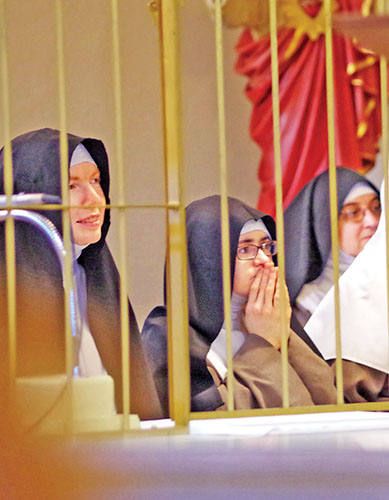
ROCKFORD—This year, the Poor Clare Colettines invite you to make a pilgrimage to their monastery at 2111 South Main Street, here, to receive God’s peace, forgiveness, and even a special Jubilee indulgence.
The pilgrimage and indulgence are part of the Church’s memorial for the 800th anniversary of the death of St. Francis of Assisi. St. Clare, a follower of St. Francis, founded the Poor Clares in the 13th century, and since then, the order has walked in his footsteps.
In January, Pope Leo XIV declared a Jubilee Year to commemorate “the happy passage of St. Francis of Assisi from earthly life to his heavenly homeland.”
He invited the faithful to attend Jubilee events in Assisi or make a Jubilee pilgrimage to 1) any Franciscan conventual church or 2) any place of worship named after St. Francis or connected to him.
Rockford Diocese has one Jubilee church
The Poor Clares’ Corpus Christi Monastery Chapel in Rockford is the only Jubilee church in the Rockford Diocese.
The Abbess of the Rockford Poor Clares, Mother Mary Laetitia of the Father of Mercies, PCC, told The Observer that a relic of St. Francis will be on display in the back of the chapel for public veneration.
The chapel will be open daily for 7 a.m. Mass and for prayer from 8 a.m. to 5 p.m. On Fridays there will be Exposition of the Blessed Sacrament until 4:10 p.m., concluding with a rosary and Benediction. Visitors can ring the doorbell at the main entrance and a sister will direct them to the chapel.
Pilgrims may receive a plenary indulgence under the usual conditions:
1) Turn away from sin.
2) Go to confession within 20 days.
3) Receive the Eucharist.
4) Pray for the pope’s intentions with an Our Father, a Hail Mary and a Glory Be.
This indulgence gives full remission of the temporal punishments of sin. (This gives the grace to heal damage done to one’s soul when he or she sins.)
The sick and homebound may also obtain an indulgence, provided that they spiritually participate, are detached from sin and intend to fulfill the three other conditions as soon as possible.
Making a pilgrimage
For one person, visiting the Poor Clares’ monastery may be as simple as going to Mass and then spending time in prayer before the rest of their day. But for groups, pilgrimage planning is more complex.
That’s where the Rockford Diocese’s Vocations Office wants to help. According to Father Jack Reichardt, director of vocations, his office has partnered with the nuns to coordinate group pilgrimages to the monastery chapel.
Online at https://www.rockfordpoorclares.org/pilgrimage are links to request a group visit, sample schedules for morning and afternoon visits, and an FAQ about group pilgrimages. Questions and topics include:
♦ Is there any cost for a pilgrimage? There’s no cost for a group, though donations of money or in-season fruits and vegetables are welcome.
♦ What is the maximum group size? Groups can be up to 75 persons.
♦ Can pilgrims meet with a Poor Clare sister? It’s not guaranteed; the sisters live regimented lives. Groups can request a talk for 30-45 minutes on all days except Fridays.
♦ What monastery areas are open to visit? The chapel, the shrine (garden) outside, and the gift shop are open.
♦ Are bathrooms available? There is a single bathroom available, which is located between the chapel and gift shop in the adjoining hallway.
♦ Is the monastery ADA accessible? Built in 1916, the monastery has several areas that require the use of stairs. Upon request, there is a single-person ADA stair chair lift with access to the chapel.
St. Francis still has much to teach, 800 years later
In his Jubilee decree, Pope Leo said that in today’s world, much like that of St. Francis, “Christian charity languishes, ignorance spreads like immorality, and those who exalt concord among peoples do so more out of selfishness than out of a sincere Christian spirit.” The teaching of St. Francis of Assisi “is perhaps even more valid and understandable today,” he said.
Whether making a pilgrimage in person or spiritually from home, “this Year of St. Francis spurs all of us, each according to our possibilities, to imitate the poor man of Assisi, to form ourselves as far as possible on the model of Christ.”