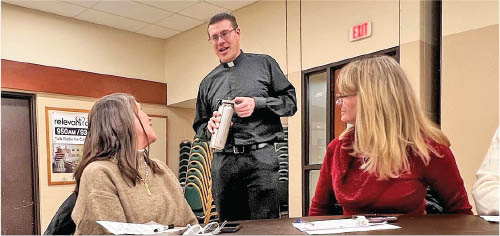
St. CHARLES—Transitional Deacon Mike Wojnarowski spent 10 years away from the faith and is now on the verge of being ordained a priest.
During January, Wojnarowski offered a series of three talks at St. Patrick Church on Crane Road, sharing his journey back to the Church in hopes of inspiring others not to lose hope and to keep praying and keep inviting loved ones back to the faith.
In addition to sharing his experience, he offered some practical advice for helping a loved one return to the faith. Some of his points (below) are based on the book Return: How to Draw Your Child Back to the Church by Brandon Vogt.
Wojnarowski said some parents feel guilty because their child doesn’t want to practice Catholicism. However, “if we feel scared, angry, anything like that, I highly encourage you to bring back the Lord in your prayer because that is not how He wants you to feel,” he said. He emphasized that “even though it is not your fault that your loved one is not currently in the Church, you are the key to them returning.”
According to both research and information in Return, Wojnarowski explained that “people leaving just gradually drifted away from the faith over time … there wasn’t this one event that caused them to leave, but just slowly over time, they decided they couldn’t believe. A feeling like their individual spiritual needs were not met. A lack of community.”
Sexual scandals in the Catholic Church have also contributed to that drift.
“But if we were to sum up all these arguments, we could say that these people feel like the Church, Catholic school, our parents, our friends, whatever, had not helped to cultivate that living relationship with Jesus,” he said.
Wojnarowski shared a list of recommendations and warned the first one may sound polemic, and he provided explanation.
- Don’t force it
Unless they are kids, “stop forcing your child to go to Mass on Sunday,” Wojnarowski said.
“Now, I’ll be clear,” he said. “This is for older and young adults, most that are in their 20s and still live at home.” He clarified: “Younger children, yes, still bring them to church. But we need to remember what the Mass is.”
The Mass isn’t really designed to be an evangelical tool to help make Catholicism appealing to somebody that’s on the outside.
The Mass, he said, particularly the Eucharist, “is the final destination for one’s evangelical journey.” If someone is forced to come to Mass, or they come and they really don’t want to be there, and receive communion without really believing it is Christ, “it could be setting them up for a spiritual sickness, or even a greater disdain for them going to church,” Wojnarowski said.
- Avoid criticizing their lifestyle
“At the end of the day… I know you all want that family member, that loved one, to embrace a relationship with Jesus. And if they do that, the drinking, the smoking, the sexual promiscuity, that will take care of itself,”
said Wojnarowski.
But scolding and nagging doesn’t work, he explained.
- Avoid simply dismissing objections to the Church
“If your child, your family member, friend, they come to you when they have a gripe about the Church, that’s actually a great thing. That means that they actually trust you enough to get what they hope is an unbiased opinion, not an angry opinion,” he told the group.
Wojnarowski suggested listening without frustration, letting the person fully explain their issue. Then you’ll “have a much better idea of how to answer their concerns.”
- Plant the seed
“If we really want to bring our loved one back to the Church, there is the assumption that I can change that,” Wojnarowski offered.
We can’t immediately create change in minds and hearts, he said. He suggested that loved ones plant the seeds and “trust that God is going to do the work when the time is right.”
- What is our game plan?
“First, we need to make sure that we ourselves are ready for this. Young people trust their friends and family more than institutions,” Wojnarowski said, “so that means not only do we need to know our stuff, we also need to be
the example.”
- Talk more to God about your loved one instead of talking to your loved one about God
“St. Monica would be speaking about Augustine, and she would just be venting her frustrations of how Augustine still isn’t embracing the faith. And St. Ambrose [St. Augustine’s friend] asked Monica, ‘Instead of always talking to Augustine about God, why don’t you try to talk more to God about Augustine?’” Wojnarowski said.
“It took years for Augustine to come back to the faith. It took a decade for me to come back to the faith, two decades for my sister to come back to the faith. So, we need to make sure that we’re constant
in prayer.”
- Fasting and prayers
“If you’re not sure how to pray, start with something simple. Start with a rosary. Start with a novena. And tell the Lord before you pray: I am praying for the conversion or the return of this loved one,” Wojnarowski suggested.
And then use your own words as well. Go to adoration and talk to God.
Fasting too is a “powerful tool that we forget about today,” he said.
The seminarian’s second talk was about tips based on the book Return and his third presentation was an evening of prayer for those who have fallen away from the faith.