Diocesan Lay Vocations:
The Third Order Carmelites of the Ancient Observance
Third Order Carmelites (TOC)
Website: http://laycarmelitespcm.org
Contact: Mai Wilson
[email protected] (469) 500-6402
By Amanda Hudson, News Editor
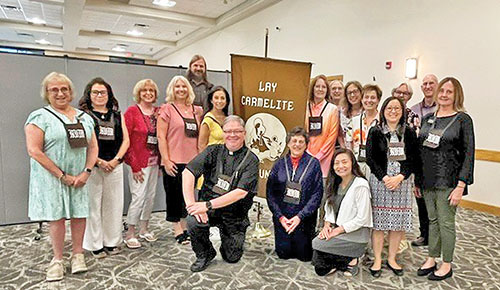
CRYSTAL LAKE—Mai Wilson, Sandy Campbell and Steve Sell are three members of the 20-member St. Joseph Lay Carmelite Community that meets monthly at St. Elizabeth Ann Seton Parish in Crystal Lake.
Much like the Secular Discalced (OCDS) Carmelites — featured in the May 22 issue of The Observer — the Third Order Carmelites (TOC) in the Rockford Diocese have ties to Carmelite priests beyond diocesan borders. In this case, it is the Ancient Order of Carmel (O.Carm.) friars in the Lay Carmelite Office at the Carmelite Spiritual Center/National Shrine of St. Thérèse (of Lisieux) in Darien. In addition to receiving regular communication from the friars, lay members attend annual days of recollection at the center, an overnight retreat provided by the friars, and a visit on the feast of Our Lady of Mt. Carmel in July on the closest Saturday to July 16, where they renew their consecration to Our Lady of Mt. Carmel and receive new members as well as make temporary and final professions. All three visits include other communities in the province.
The TOC follows both the Rule of St. Albert and its own “Carmel’s Call” rule book. Its larger structure includes international, national, provincial and regional leaders. A diocesan priest, Father Brian Grady, former pastor of St. Elizabeth Ann Seton Parish who now serves as pastor of St. Rita Parish in Rockford, is a permanently professed member of the TOC and is the community’s spiritual assistant.
Adult Catholics in good standing and registered at a parish can ask to begin the multi-year journey of discernment that begins with an initial year of study via at least three community meetings. The community’s study year begins in September.
After the initial study year, potential TOC members meet with a formator in the morning before the community’s monthly meetings and study the history of the Carmelites. That is followed by three years of “Phase 2” formation.
The community council interviews candidates before each step, including the final step of making lifelong promises.
The monthly meetings of the St. Joseph community are held on Wednesdays from 12 to 3 p.m. The meetings begin with Mass, prayer from the Liturgy of the Hours and a half hour of lectio divina. News from the Darien friars is shared and local business is discussed. That is followed by an hour and a half of ongoing formation focused on a chosen Carmelite-themed book each year that is discussed in small groups.
Mai Wilson
Mai Wilson heard about the TOC from Father Grady and began her formation in 2014. Her vocation, she says, has been “an anchor in the difficult and challenging moments when the world clamors for all my attention. It makes me pause and chose to continually commit myself to the call of being a TOC, striving to have Jesus Christ as the center of my life.”
Wilson was elected director of the community in March, heading up its community council that also includes a secretary, formation director and spiritual assistant.
Wilson identifies the “three main charisms” of a TOC as prayer, community and service. “Personally, praying the Liturgy of the Hours has really elevated and deepened my prayer life,” Wilson says, pointing to the prayers of praise in particular.
Community, she says, includes regularly attending the monthly meetings and three yearly retreats to the Carmelite center in Darien, saying it “supports our shared journeys in Carmel and also our vocation in the world.”
Service includes duties within the community, donations to Carmelite convents, and serving “actively in (our) parish(es) in various way to which (we) are called,” Wilson says.
Sandy Campbell
Sandy Campbell says she fell in love with St. Thérèse of
Lisieux and her quest for Carmel when she was in second grade and read “St. Thérèse and the Roses,” reading it every year until she graduated from eighth grade.
“Unlike St. Thérèse, though, I did not have a calling to a vocation in a Carmelite cloister,” Campbell says, noting, “From conception to present I have had many physical challenges, but always saw them as an opportunity to serve the Lord and be an example to others.”
A member of St. Elizabeth Ann Seton Parish, one day Campbell noticed a woman wearing a brown scapular. Responding to her question, the woman explained about the lay Carmelite group at the parish and invited her to explore a lay vocation.
“My thought at the time (was that) I am not worthy or holy enough,” Campbell says. “I remember my first Carmel meeting feeling out of my league, especially when it came to the group’s ongoing formation book, ‘Ascent of Mt. Carmel’ by St. John of the Cross. Regardless, I kept coming and felt very welcomed and encouraged.”
Campbell began formation in 2020. “Lectio Divina and Liturgy of the Hours became part of my daily routine and as time passed I loved the quiet time and structure provided. I felt part of something bigger than myself,” she says, adding that, “Six years passed quickly. On July 18 … I (made) my final profession. Spiritually I feel like a different person. For the first time in my formation process, I have no doubts (that) this is my calling.”
Among a long list of “lessons I hold dearest to my heart,” Campbell points to “total trust and surrender” to God, being kind to others and a good example, a new “obsession” with Scripture, and the “comfort zone” of like-minded “brothers and sisters” at monthly meetings.
Campbell also has learned about prayer. “Before Carmel I always felt I had to ‘do something’ when praying — a rosary, devotions, set prayers, etc. Now I realize these are foundations, but listening is the cherry on the sundae,” she says.
She has grown to become a formator in the community, and she doesn’t mind revisiting what she learned during her formation. “My favorite discovery about myself going through the material again is — I’ve grown!” she says. Her current answers, she says, “are deeper.”
Steve Sell
Steve Sell came into the Catholic Church with his wife in 2014.
“Afterward, I still had a desire to learn more about the faith and deepen my spiritual life,” he says. “I would go to daily Mass at SS. Peter and Paul in Cary where I lived and sometimes bring a book to
read afterward.
“Another daily Mass attendee noticed I was reading about St. Teresa of Ávila and started a conversation, leading up to inviting me to the Carmelite monthly meeting. I enjoyed it and felt a sense of belonging from the beginning.”
He explains “one key insight” he has learned through Carmel: that his “good intentions and a desire to live up to what God is calling me to do” had brought him concern and even discouragement “when I saw sins and imperfections in my life.”
Carmelite spirituality, plus some guidance from a Carmelite priest, helped him understand that “we need to remain at peace and trust in God to help us grow in perfection,” and such concerns “need to be balanced with confidence in God — and ultimately all the details of our spiritual life need to be subordinated to a genuine relationship with God that is intimate and loving. Within that secure relationship is where we work out our salvation, and God is always merciful and patient with us.”
Sell says that his vocation is “complementary” to his roles as a husband and father.
“The Carmelite vocation is not a competing responsibility to my family life or work, but rather something that gives me nourishment and perspective on how to approach those duties,” he says. “The call to prudence, as in the rule, which says common sense is above every law, is very reassuring.
“The Carmelite vocation,” he adds, “would rightly put community duties under the responsibilities of family life or trying to manage health issues. So, it adds reassurance in those times instead of the stress or uncertainty of a competing duty.”
Sell hopes to encourage others “to continue trying to develop a life of prayer,” both through liturgy and private prayer.
“Perhaps there are times, especially at the beginning, where there may be uncertainty at how to pray or what to do,” he says. “Not everyone is called to a third order, and the secular orders aren’t inherently superior to other devotions or groups.
“But as we continue to seek God, and to grow (in) intimacy with Him and prayer, we have the hope that God will lead us to the best place and the ways to do that. And the orders are one of those ways.”
History
Third Order Carmelites (TOC) are lay people who are at least 18 years of age, Catholic, and in full communion with the Church. They are called to live more deeply their baptismal promises.
The Lay Carmelite follows the mission of Carmel (also the mission of the Church) which is to transform the secular world after the teachings of Jesus. This is accomplished through the Carmelite charism and dedication to prayer, community and service. Most important is to remember that being a Lay Carmelite is not just a devotion added to life; it is a way of life — a vocation.
Lay Carmelites usually make promises of obedience, chastity, and poverty (or detachment) rather than formal vows, committing to live the Gospel in their state of life according to Carmelite spirituality. Their spirituality centers on seeking God’s presence, modeled after Mary and Elijah.
The third order of the Carmelite Order of the Ancient Observance was established in the mid-1400s by a papal bull. The rule observed by the tertiaries (third order) was originally that of the friars with modifications as required by their status.
In 1635, Theodor Stratius, General of the Carmelites of the Ancient Observance, composed a new rule, which was revised in 1678.
As is found in both Lay Carmelite orders, there are ordained ministers (deacons, priests and bishops) who are professed members of Secular/Third Orders. Bishop Fulton Sheen, for example, was a Lay Carmelite, making his profession in 1948.
The charism of Lay Carmelites is contemplative prayer, community, and ministry/service. Apart from attending a monthly community meeting, Lay Carmelites wear the Brown Scapular of Our Lady of Mt. Carmel as an external sign of dedication to Mary and of trust in her protection. They are expected to participate in the daily celebration of the Eucharist when possible and should spend about one half-hour in meditation each day, reflecting on the Scriptures, Lectio Divina, or some other appropriate type of personal reflective prayer. The Lay Carmelite also prays the Liturgy of the Hours — Morning and Evening Prayer.
“Its members, responding to a special call of God, freely and deliberately commit themselves (to live) according to the charism, traditions, and spirit of Carmel under the authority of the Prior General of the Carmelite Order. Members are brothers and sisters of the Carmelite Family and sharers in the same call to holiness and in the same mission of the Carmelite Order,” says the general website of the St. Joseph TOC community:
http://laycarmelitespcm.org